Eloquence of the Torah
As manifested in Arabic literature

Eloquence, not surprisingly, is a common quality of all sacred texts. And the Torah1 is no exception. I came across the excerpt below, which is an extract from the Torah, in the book Al-Mustatraf fi Kull Fan Mustazraf. This is an Arabic literary work written by Shihab al-Din Ahmad al-Abshihi in the 15th century.
The book is a collection of stories, proverbs, and poetry from various sources, including Islamic teachings, Arab traditions, and historical accounts. It discusses religion, philosophy, humor, love, governance, and human nature, making it a rich source of cultural knowledge. It has been widely read and referenced by scholars and writers due to its encyclopedic nature and engaging storytelling.
This is the excerpt:
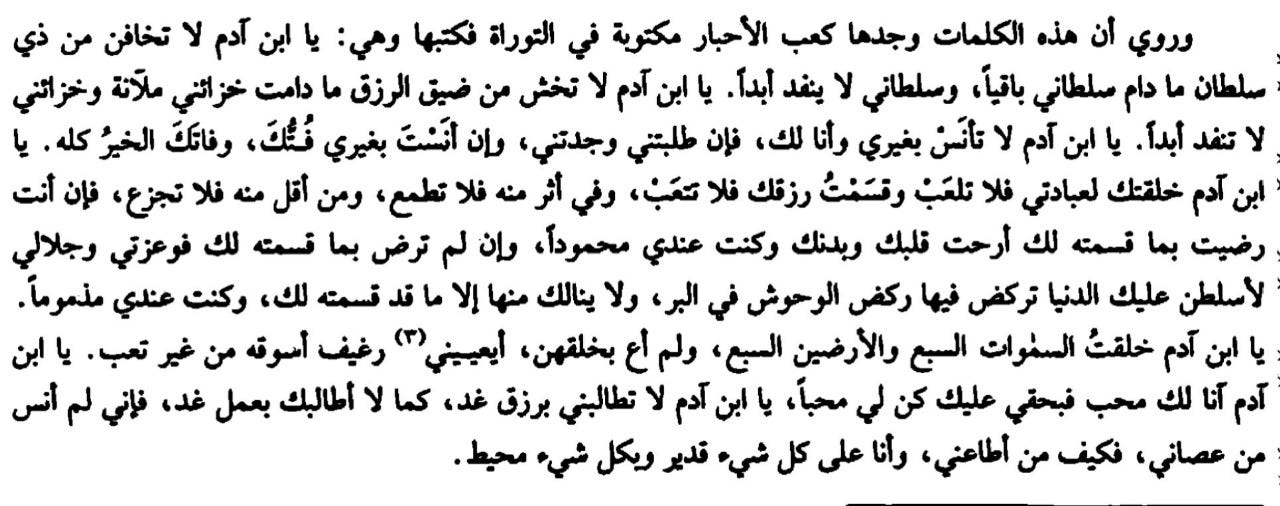
And here is the literal translation:
It is related that K’ab al-Ahbaar found these words in the Torah and wrote them down:
O Son of Adam do not fear those who hold power so long as My Power remains. And (remember) My Power will never be depleted.
O Son of Adam do not dread indigence so long as My Chests (of treasure) are full. And (remember) My Chests will never be depleted.
O Son of Adam do not take refuge with anyone other than Me. I am with you. And if you seek Me, you will find Me. And if you take refuge with other than Me, you will lose Me and (then) all good will escape you.
O Son of Adam I created you to worship Me so do not be distracted. And I have apportioned for you your livelihood so do not exhaust yourself (in seeking it). And do not covet more. And do not be distressed with less. And if you are content with what I have apportioned you will soothe your heart and body and you will be amongst those who have My Favour.
And if you are not content with what I have apportioned for you, I swear, by My Power and by My Majesty, that I will impose upon you the Dunya2. In it you will run with the beasts of the earth. And you will not gain of it other than what I have apportioned. And you will be amongst those I revile.
O Son of Adam I created the seven heavens and the seven earths and their creation did not exhaust me. Will giving (you) a few crumbs without effort exhaust Me?!
O Son of Adam you are beloved to Me so it is My right that you love Me.
O Son of Adam do not demand of me sustenance for tomorrow, just as I do not demand endeavor from you for tomorrow.
Indeed I do not neglect (to be merciful to) those who disobey Me. So how will it be for those who obey Me?
Indeed I have power over everything. And I surround everything.
Ka'b al-Ahbaar, to whom the excerpt is attributed was a 7th-century Yemenite Jew who later converted to Islam. He was known for his deep knowledge of Israʼiliyyat (Jewish traditions) and South Arabian lore. He is believed to have traveled to Medina during the reign of the Caliph Omar, accompanying him on his journey to Jerusalem
The Torah is held by all Muslims to be a sacred scripture. And Moses, to whom it was revealed, to be a revered prophet of God. Just as we hold the Bible to be a sacred text and revere Jesus (‘Isaa in the Quran) as a beloved prophet of God.
Dunya is an Arabic word meaning the world. In the context here it is used to mean the temporary pleasures of life in this world in contrast to the everlasting bliss of the afterlife.